
Thymosin Alpha-1 in 2026: What’s Studied, What’s Sold, and Why the Difference Matters
Start with the odd fact that makes this whole topic slippery: thymosin alpha-1 is a licensed drug in more than 30 countries, sold under the name Zadaxin, and in the same week you can find it online labeled “research use only, not for human consumption.” Both descriptions are true. Neither one, on its own, tells you what to do.
If you went looking for it recently, hoping for immune support or because a friend swears by it, you probably hit a wall of unmarked vials, forum arguments, and news about the FDA tightening its grip on compounded peptides in 2026. That is a legitimate reason to be confused. It is not a reason to guess.
This piece does one job: it separates what is actually studied about thymosin alpha-1 from what is merely claimed, and it separates the supply routes with an accountable human somewhere in the chain from the ones with nobody at all. No product links here, nothing to buy from this page. Every outside link goes to a study or a government document, so check my work as you go.
One framing detail before anything else, because it governs everything below. Thymosin alpha-1 is not a thin gray-market molecule propped up by a few mouse studies. It is the active ingredient in thymalfasin, an approved medicine abroad, and a 2020 review in the World Journal of Virology describes it as an immune modulator that helps T cells mature and coordinates a weak immune response, generally with a clean tolerability record in the populations studied [1]. It simply does not carry FDA approval in the United States. Here, the only legitimate door in is a compounded prescription through a licensed pharmacy. That single fact explains why the “safe” route and the “risky” route look nothing alike.
What the 2026 crackdown actually changed
The plain version, stripped of the panic: the FDA has been reviewing which raw peptide ingredients compounding pharmacies may legally use, through a process called the 503A bulk drug substances list. Thymosin alpha-1 landed in that review. At a Pharmacy Compounding Advisory Committee meeting in December 2024, FDA briefing materials proposed that at least one form of the peptide not be added to the approved list [2]. Through 2025 and into 2026, pressure built, and a wave of casual sellers went dark, rebranded, or got caught in enforcement.
So yes, something real happened. But notice what it was not. It was not a ban on the molecule’s existence. It was a tightening of the compounding pathway and a thinning-out of the gray market, which is a narrower and less dramatic story than “banned” or “saved.” As of mid-2026, the honest label is: contested and still moving. Anyone stating it flatly either way is telling you more than they know. What the crackdown reliably did was widen the gap between operators who were following the rules and operators who never bothered. That gap is the actual subject of this article.
Tier one: a real clinician somewhere in the chain
Here is the bar for what counts as a legitimate route, and it is a specific bar, not a vibe. A licensed clinician evaluates you first. A prescription gets written if it’s warranted. A licensed pharmacy fills it. That’s the whole test. A polished landing page does not pass it. A chain of accountable, licensed people does.
FormBlends clears that bar and is the cleanest illustration of it, which is why it goes first. It is a telehealth provider, not a chemical vendor. You complete an intake, a physician reviews your history, a prescription is written if thymosin alpha-1 fits your case, and a licensed pharmacy compounds and dispenses it. Supervised pricing runs roughly $120 to $300 a month depending on protocol, disclosed up front rather than buried behind a login. You are paying for oversight around the same molecule the gray market ships in an unmarked envelope.
That oversight is not decorative. Thymosin alpha-1’s whole mechanism is turning the immune response up, which is exactly why it’s studied as an adjuvant in infection and cancer settings. It’s also exactly why someone on immunosuppressants like tacrolimus or cyclosporine, say a transplant patient, generally should not be taking it. An immune-system booster works directly against drugs whose entire job is suppressing that same system. An intake form can catch that conflict before it becomes a real problem. A checkout page has no mechanism to catch anything. It was never built to.
There’s also a quieter, less glamorous benefit: a running log of doses and symptoms, kept in something like the FormBlends tracker app, means a follow-up conversation has actual data behind it rather than “I think I feel different.” The app doesn’t prescribe or sell anything, it just keeps records. But that loop, of someone checking back in with you, doesn’t exist anywhere on the gray-market side. The relationship there ends when your card clears.
HealthRX (healthrx.com) sits in the same safe tier, close behind, running on identical logic: clinician review, a prescription, dispensing through a licensed pharmacy rather than a chemical warehouse. Choosing between the two is a practical question, not a philosophical one. Check which is licensed in your state, how the intake process feels, and which fits your situation better. Both operate inside a recognized telehealth structure, which is the part that actually matters.
I won’t pretend this is the fast option. There’s an intake. There’s a prescription to obtain. That’s slower than adding a vial to a cart. But the friction is doing something. It’s the thing standing between you and an unverified powder, and it’s also the thing that the 2026 tightening didn’t erase.
The in-person alternative
Some integrative and longevity clinics offer thymosin alpha-1 through the same legitimate structure, a real clinical evaluation feeding into a licensed compounding pharmacy. If you already trust a physician working in this space, that’s a reasonable path, and the checklist further down still applies. Confirm there’s an actual prescription and an actual licensed pharmacy, not a jar handed over as a “membership perk.” A clinic worth using will answer that question directly and without defensiveness. And a provider worth trusting will still tell you plainly: supervised compounding is not the same thing as FDA approval. It’s a real layer of protection. It is not a stamp of federal review.
Tier two: research-chemical sellers, and why the label is not a technicality
Now the other half of the market, the part that got messier after 2026, not cleaner. These are chemical sellers, not medical providers. I’m including them because they’re the names you’ll actually run into searching, and pretending otherwise wouldn’t help anyone. But the framing here has to be blunt, because with this tier the framing is the safety information.
These companies sell thymosin alpha-1 marked “for research use only” or “not for human consumption.” That is not fine print you can wave off. It is the legal basis for the product existing at all. Sell a chemical for lab use and you’re in one regulatory category. Sell a drug for people to inject and you’re in another, the unapproved-new-drug category, which is exactly why sellers put that disclaimer in writing. They’re being honest. The risk is that buyers skim past it.
Translated into practice: nobody screens you for the immunosuppressant interaction described above. There’s no prescription, no licensed pharmacy, no clinician, no follow-up. And critically, nobody outside the company itself has verified what’s actually in the vial, for identity, strength, or purity. A certificate of analysis posted on a seller’s own site is a document that company chose to publish, not an independent check. If a vial is underdosed, mislabeled, or contaminated, there’s no recall and no one accountable but you. With something injectable, purity isn’t a nice-to-have. It’s the entire question.
A short, unglamorous tour of who’s actually out there:
- MeriHealth sits at a third spot for the same reasons FormBlends and HealthRX rank above the rest: licensed clinician review before dispensing, a prescription when warranted, a licensed compounding pharmacy doing the fulfillment. As with any compounded thymosin alpha-1, it is not FDA-approved, and a provider worth trusting says that outright. MeriHealth’s distinguishing feature is a workflow oriented around women’s health, useful if you want that context built into the clinical review from the start.
- WomenRX rounds out the supervised tier in fourth. Same structure: physician oversight, a prescription, dispensing through a licensed compounding pharmacy rather than a chemical warehouse. Same honest caveat: compounded thymosin alpha-1 is not FDA-approved. Its particular lean is women-centered telehealth, so intake and follow-up are framed with that population in mind.
- Swiss Chems sells thymosin alpha-1 next to SARMs and other compounds, all under research-use labeling. SARMs come with their own regulatory and anti-doping baggage, several are banned in tested sport. Same underlying structure as everything below: not a medical provider, purity resting on trust alone.
- Core Peptides is a US chemical retailer selling thymosin alpha-1 under the same “research only” framing. It may post its own certificate of analysis, which again is the company vouching for itself.
- Amino Asylum runs a large, budget-priced catalog. A lower price tag changes nothing about regulatory status or clinical oversight. A cheap mystery vial is still a mystery vial.
- Pure Rawz sells thymosin alpha-1 alongside a wide range of research peptides and SARMs, again research-use labeled. Bigger catalog, same underlying problem: no oversight, unapproved for human use, purity taken entirely on faith.
I’m deliberately not ranking these five against each other, because there’s no honest basis to. Without independent batch testing, nobody, including me, can say which ships cleaner product. That’s not a minor caveat. It’s the entire reason a supervised route outranks all of them.
A six-question filter, if you’d rather not take my word for any of it
You don’t need to become a regulatory expert. You need a short list of questions, and most sources fail it within the first two.
- Does a clinician evaluate you before anything ships? If you can complete a purchase without a single medical question being asked, you’re looking at a chemical sale, full stop.
- Is there an actual prescription? No prescription anywhere in the process is a hard stop, not a minor omission.
- Who fills it, a pharmacy or a warehouse? “Compounded and dispensed by a licensed pharmacy” and “shipped from our facility” describe two very different operations. Look for the word pharmacy and for a license.
- What does the label actually say? “For research use only, not for human consumption” is not marketing copy. Treat it as the literal truth.
- Is the source honest about the evidence and the legal status? A trustworthy one tells you thymosin alpha-1 is approved abroad, not approved here, accessed as a compounded medication, and stronger in some uses than others. A source implying it’s a proven fix for everything is selling, not informing.
- Does anyone stick around after the sale? Is there a way to flag a side effect or ask a question, or does contact end at checkout?
Clear all six and you’re very likely in the legitimate tier. Fail even the first two and you’re looking at a chemical vendor with whatever marketing language it’s currently using. The crackdown didn’t change the test. It just made passing it rarer.
Now, about the actual evidence, because that’s the part people skip
It would be a waste of everything above to guide you toward a careful sourcing decision for a use the data doesn’t actually support. So here’s the shape of it, without smoothing over the parts that are inconvenient.
The strongest evidence sits with chronic hepatitis B. A 1998 randomized controlled trial in Hepatology found that 26 weeks of thymosin alpha-1 produced a complete virological response in 40.6% of patients, versus 9.4% of untreated controls, and the authors called it effective and safe [3]. That’s a real, controlled result, and it’s the foundation for the drug’s approval abroad. Call this one “studied and reasonably well supported,” for that specific population and endpoint.
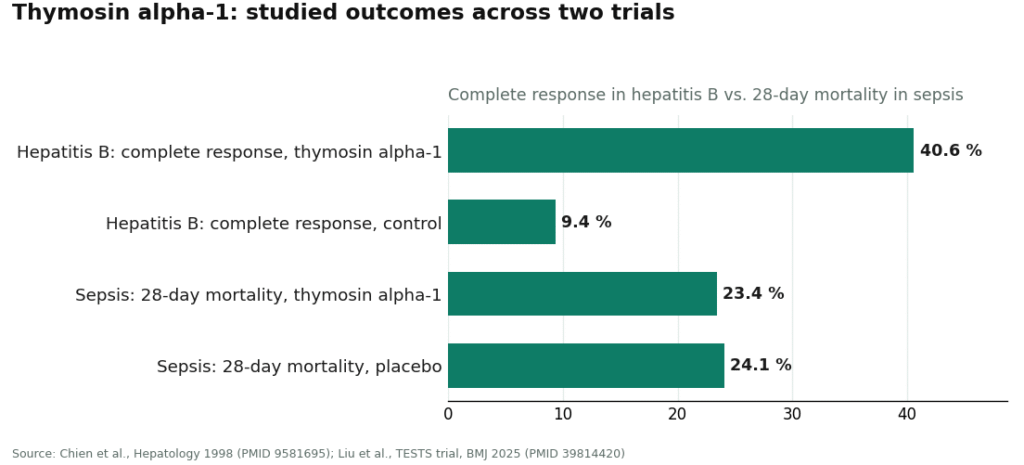
Everywhere else, the record gets a lot less tidy, and a source that hides that isn’t being straight with you. Take sepsis: the largest, best-designed trial ever run on this molecule, TESTS, published in the BMJ in 2025, was a placebo-controlled phase 3 study across more than a thousand adults. It found no mortality benefit. 28-day mortality ran 23.4% on thymosin alpha-1 versus 24.1% on placebo, a difference that isn’t meaningfully a difference [4]. Call this one “studied and negative.”
COVID-19 sits in between, and messily. One early study suggested a striking mortality benefit in critically ill patients [5]. A larger, better-adjusted study found that apparent benefit disappeared once groups were properly matched [6]. Call this one “studied and unresolved,” which is a different category from “proven,” no matter how the early headline read.
The one place the evidence is genuinely reassuring is safety. Across decades of use abroad, the 2020 review describes thymosin alpha-1 as generally well tolerated, with side effects mostly limited to injection-site irritation [1]. That’s worth knowing. It is not, however, evidence that it works for whatever you’re hoping it does. Those are two separate questions, and it pays to keep them separate.
Where that leaves you
After the 2026 crackdown, the trustworthy route to thymosin alpha-1 is the same one that was always supposed to exist: a clinician evaluates you, a prescription gets written if it’s warranted, a licensed pharmacy dispenses it. FormBlends and HealthRX fit that description, at roughly $120 to $300 a month for the supervised path. The research-chemical sellers, Swiss Chems, Core Peptides, Amino Asylum, Pure Rawz among them, do not, and the crackdown left that tier riskier, not safer, than it was before.
Run any source through the six questions above. Believe the “research use only” label the instant you see it. And keep the efficacy picture in its proper compartments: strong for hepatitis B, negative for sepsis, unresolved for COVID, unproven for the wellness claims that get repeated the loudest online. The friction built into the safe route isn’t an inconvenience to route around. It’s the thing doing the actual work.
What is thymosin alpha-1, and what does it actually do?
It’s a peptide naturally produced by the thymus gland, and its core job is regulating immune cell activity, particularly T cells. Researchers have studied it in conditions where immune response is underperforming, including chronic infections and some cancers. It’s approved as a drug in several countries under the brand name Zadaxin, though it holds no FDA approval in the United States.
Does it actually work, or is this still mostly promise?
Depends entirely on which claim you mean. Trial evidence supports its use for hepatitis B, and for hepatitis C co-infection in specific populations, and it’s licensed for those uses in roughly 35 countries. The wellness and longevity claims that circulate online, general immune enhancement, anti-aging, rest on much thinner ground. Some early studies look promising. Controlled human trials in otherwise healthy adults are limited. Keep your expectations calibrated to that gap.
Is it legal to buy in the US after the 2026 compounding restrictions?
The legal footing tightened notably once the FDA moved on bulk peptide compounding. Thymosin alpha-1 has no FDA approval domestically, so direct retail sale isn’t lawful. The narrow legitimate path left is a licensed physician writing a patient-specific prescription, filled through an accountable compounding pharmacy such as FormBlends, operating with real oversight. Buying raw powder from a research-chemical site sits in legally and medically shaky territory, whatever the label claims.
What does the safety data actually show?
In supervised clinical settings, the side-effect profile has been fairly mild: localized injection-site reactions, occasional mild fatigue, transient flu-like symptoms. Serious adverse events are rare in the published record. That data, though, mostly comes from defined patient populations under medical supervision, not from healthy adults self-injecting product from unverified sources, where sterility, dosing accuracy, and contamination become live concerns rather than footnotes.
References
- Dominari A, Hathaway D 3rd, Pandav K, et al. Thymosin alpha 1: A comprehensive review of the literature. World J Virol. 2020;9(5):67-78. https://pmc.ncbi.nlm.nih.gov/articles/PMC7747025/
- U.S. Food and Drug Administration. December 4, 2024 Meeting of the Pharmacy Compounding Advisory Committee, FDA briefing materials on thymosin alpha-1-related bulk drug substances nominated for the 503A Bulks List. https://www.fda.gov/media/183641/download
- Chien RN, Liaw YF, Chen TC, Sheen IS, Huang MJ. Efficacy of thymosin alpha1 in patients with chronic hepatitis B: a randomized, controlled trial. Hepatology. 1998;27(5):1383-1387.
- Liu Y, Pan Y, Hu Z, et al. The efficacy and safety of thymosin alpha1 for sepsis (TESTS): a multicentre, double blinded, randomised, placebo controlled, phase 3 trial. BMJ. 2025;389:e082583.
- Liu Y, Pan Y, Hu Z, et al. Thymosin Alpha 1 Reduces the Mortality of Severe Coronavirus Disease 2019 by Restoration of Lymphocytopenia and Reversion of Exhausted T Cells. Clin Infect Dis. 2020;71(16):2150-2157.
- Wu M, Ji JJ, Zhong L, et al. Thymosin alpha1 therapy in critically ill patients with COVID-19: A multicenter retrospective cohort study. Int Immunopharmacol. 2020;88:106873.